
Analysis
Integr8: Have bunker prices outpaced the rest of the oil market?
Latest analysis highlights that bunker fuel prices, particularly VLSFO, have risen significantly more than crude in key regions, with Asia experiencing the most extreme price jumps.

By Steve Christy, Research Contributor, Integr8 Fuels
[email protected]
19 March 2025
Last month we wrote about a floor to bunker prices: what next?
Last month’s report on a floor to oil and bunker prices seemed an appropriate topic at the time, and the conclusion was Brent in the $40s and VLSFO in the $300s. Four weeks later, it looks like the report is already redundant and can be shelved for the foreseeable future.
Events and ‘Trump-led’ politics have caused chaos. From a commercial perspective, the closure of the Strait of Hormuz means oil is at the forefront of developments across global markets, and we are in the thick of it.
VLSFO up by more than crude, especially in Singapore
When it comes to headlines on oil pricing in the global media, it usually starts with crude, and then possibly gasoline. But behind the headlines, there is a lot more going on. The graph below (with left and right axes scaled the same) just about summarises everything for us in bunkers.
Headline Brent prices are just above $100/bbl, up by around $30/bbl (plus 45%) since the week before the war (although there was an intra-day high of $116/bbl on 9 March). However, bunker prices are up by significantly more than crude, with Rotterdam VLSFO prices up $340/mt and Singapore prices up a massive $635/mt, more than double their pre-war levels.
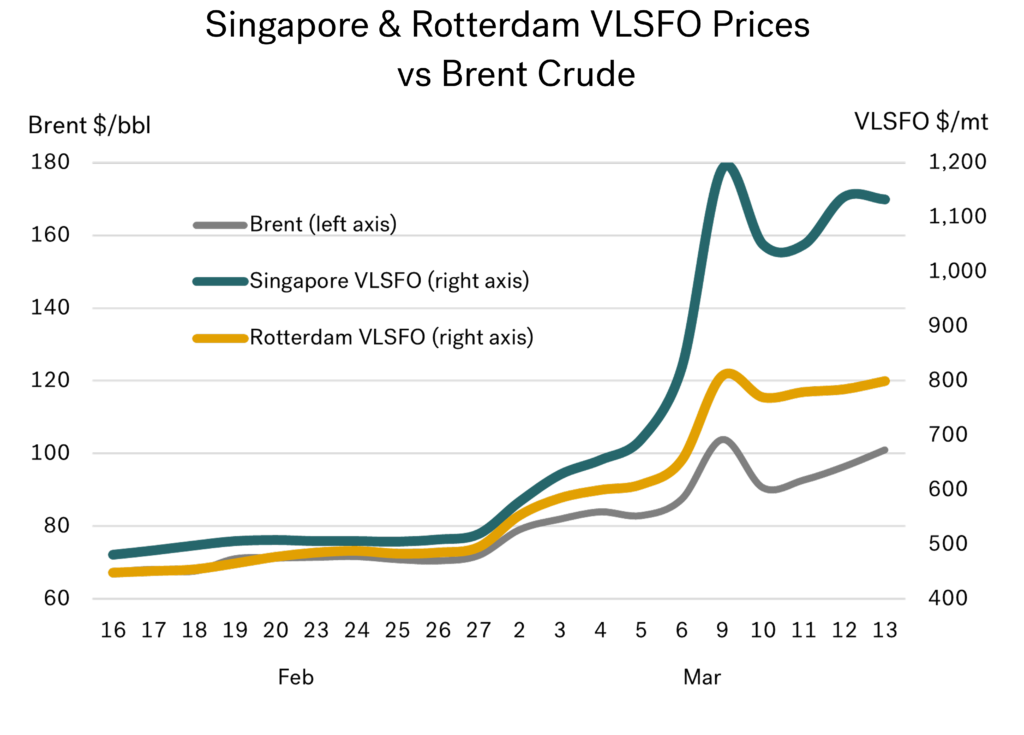
The outcome is clear, VLSFO prices have risen much higher than benchmark crude and the leap in Singapore VLSFO prices has been a lot more extreme than in Northwest Europe.
What has happened to VLSFO prices around the world?
The graph below looks at key regional VLSFO prices, indexed against their weekly average for 16–20 February (i.e. before any significant expectations of the start of US/Israeli attacks on Iran on 28 February). We have deliberately left the Middle East out of this analysis.
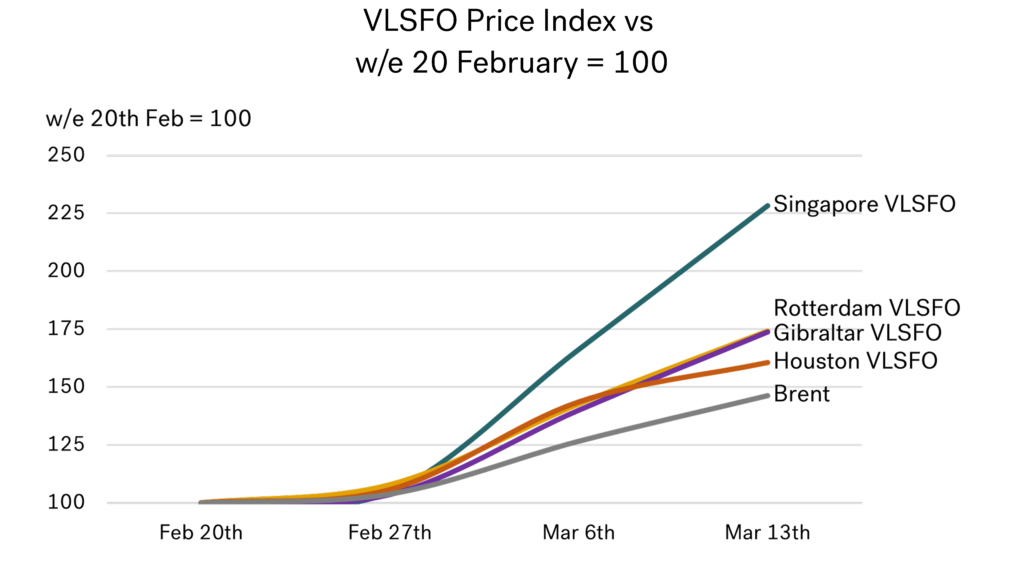
This shows that the main regional VLSFO price rises have been greater than for Brent crude, but the increase in US Gulf prices was less than in Europe, which in turn was significantly less than in Asia.
Looking more closely at what has happened to VLSFO prices around the world, there is a clear case that pricing pressures become more intensive as you move from west to east.
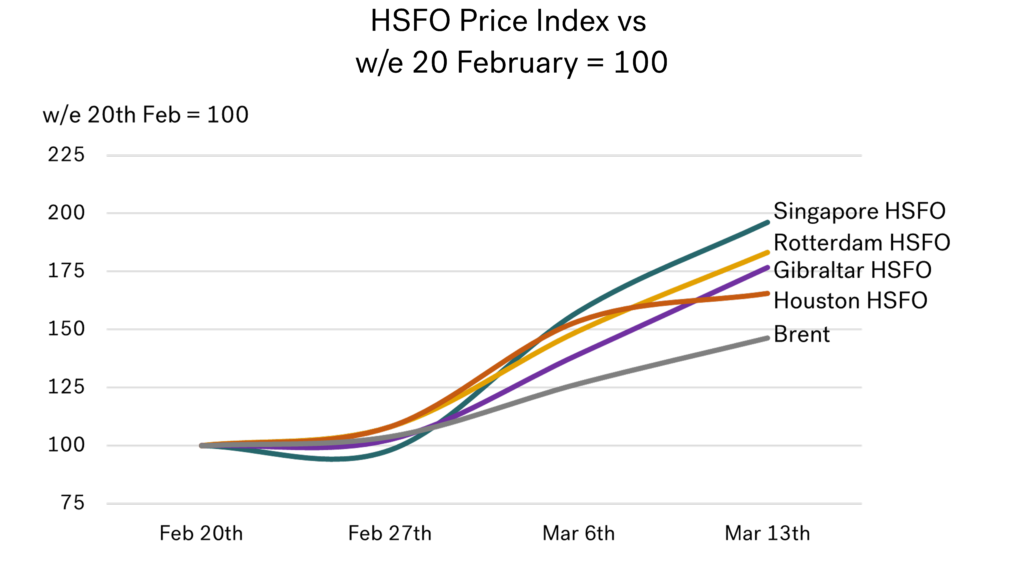
It’s the same for HSFO: price hikes bigger than crude, with Singapore at an extreme
The trend is the same for HSFO. All price increases are greater than for crude, and the increases get bigger as you move from the US Gulf to Europe and then on to Asia. In the US Gulf, again, HSFO prices are ‘only’ 65% higher than pre-war levels (plus $250/mt), whereas European markets are some 85% higher (plus $350/mt) and Singapore 100% higher than in mid-February (plus $425/mt).
The brief explanation is straightforward, as the majority of Middle East crude and product exports go east, and so a closure of the Strait affects Asian markets more than others. However, there are always knock-on effects that exacerbate the situation. In this case, an obvious tightening in Asian markets has meant China and India have responded by shutting down their product export markets in defence of their own domestic requirements.
This has therefore tightened Asian markets even further and created greater uncertainty about availabilities and pricing in the near term. If that is not enough, the squeeze on European markets and extremely high freight costs have meant the ‘normal’ product flows from Europe to Asia have also come to a halt.
It does not look easy for anyone buying bunkers right now, but if you must rank them, Asian pricing is suffering more.
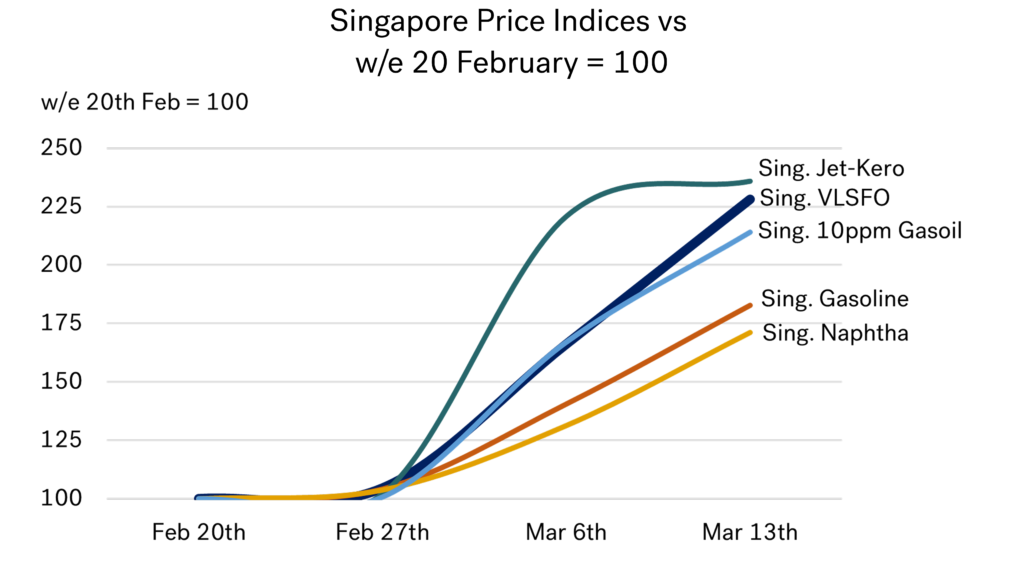
How does VLSFO compare with other products in Singapore?
There is no doubt that the jet fuel market has come under huge pressure. Significant jet export volumes come out of the Middle East, and the ability to ramp up production elsewhere in the world is severely limited. Jet is almost entirely a straight-run product out of the refinery, and the vast majority of the world’s spare capacity is located in the Middle East.
Hence, when the war started, there was a near-instantaneous spike in jet prices, with Singapore jet-kero quotes more than doubling in the first week of the war. However, in the second week, prices then more or less stabilised. It was in the second week that we in bunkers began to feel the same extreme pricing pressures, and this is when our market ‘ran away’.
So now, the Singapore VLSFO market is in the same bracket as the Singapore jet market (and the 10ppm gasoil market), where prices have more than doubled in just two weeks. It’s difficult to say that Singapore gasoline and naphtha markets have fared better, with price rises of around 75% in two weeks, but it’s all relative!
How have bunker markets fared in other international markets?
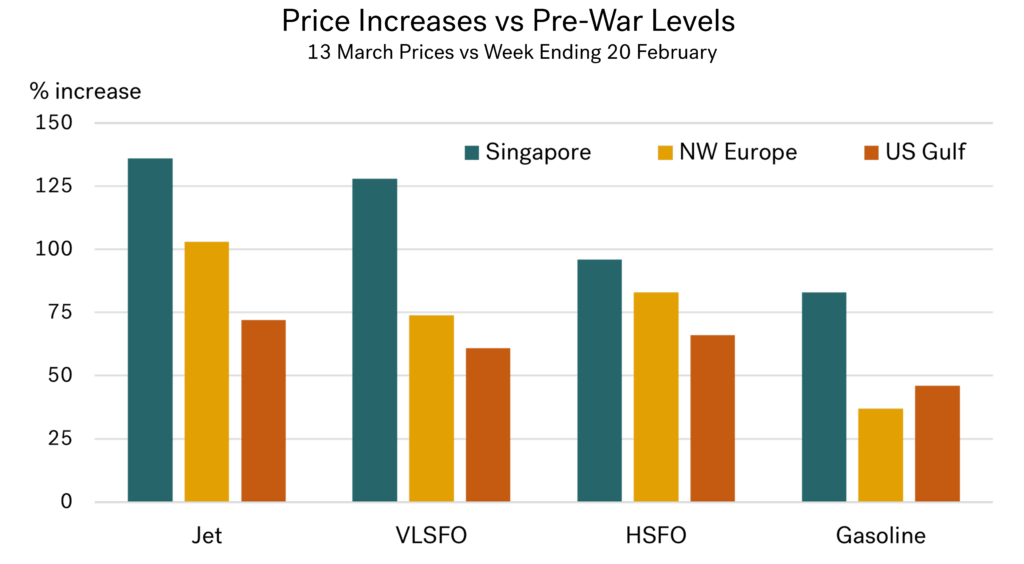
If we compare percentage price increases for bunkers against jet and gasoline over the first two weeks of the war, then the graph below illustrates that the biggest gains across these products have been in Asia, followed typically by Europe, and finally the US. It also shows that bunker price increases have been close to what is happening in the jet market, and higher than gasoline in each of the main markets; we in bunkers have seen some of the biggest percentage price hikes in each region.
What is being done to ease prices?
There have been attempts to ease market pressures. The IEA has announced its biggest ever release of strategic stocks, at 400 million barrels. However, this can only help to a limited extent over a brief period. Also, a greater proportion of the release is in the West, whereas the greatest need is in the East. This raises further questions, such as whether there is a willingness, or even the ability, to trade these stocks to other countries and regions.
There are also talks to establish an international naval presence to protect shipping going through the Strait of Hormuz, although at the time of writing nothing had been finalised. There are further questions here about the willingness, the rates, and the insurance cover of merchant ships transiting the area.
Ultimately, it is only the resumption of Middle East oil production and refining operations, and the safe reopening of the Strait of Hormuz, that will bring prices down to more settled levels.
Let’s hope this report becomes redundant as quickly as the last one!
The time between writing, publishing, and reading this report can be an age in these chaotic times. Let’s hope this month’s report becomes redundant just as quickly as last month’s report looking at a floor to VLSFO prices in the $300s!
Photo credit: Integr8 Fuels
Published: 25 March, 2026
Bunker Fuel Quality
FOBAS report warns of growing operational risks from ISO-compliant bunker fuels
LR’s latest FOBAS Fuel Quality Report reveals that the biggest fuel quality risks are no longer confined to off-specification fuels, with some compliant fuels creating operational challenges.
Interview
Interview: Alkagesta navigates risk from bunkering ops during turbulent times
As the industry navigates this period of uncertainty, the key question is no longer ‘what will fuel cost?’ but rather ‘will fuel be available?’, highlights Mithat Çiftçioğlu.

Analysis
T&E: Overreliance on traditional bunker fuels costs shipping USD 395 million a day due to Iran conflict
Development has made alternative fuels increasingly more competitive, states Eloi Nordé, shipping policy officer at T&E.
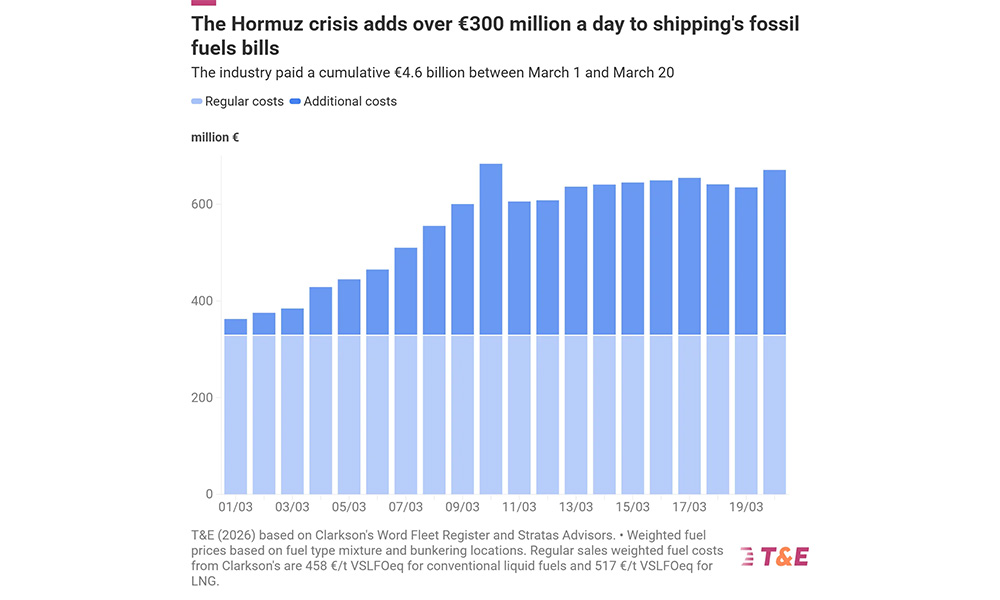
The European Federation for Transport and Environment (T&E) on 27 March highlighted the adoption of green marine fuels would reduce the shipping industry’s exposure to fuel price shocks in future.
It noted shipping companies are spending an extra €340 million (USD 394.74 million) a day in additional fuel costs as a result of the latest conflict in the Gulf.
As 99% of the global fleet runs on fossil fuels, the industry is directly exposed to fuel price volatility and supply disruptions. Efficiency measures, electrification and e-fuels would reduce the industry’s exposure to price fluctuations.
According to T&E, marine fuel prices have escalated rapidly, with VLSFO reaching €941 per tonne in Singapore, up 223% since the start of 2026. At the same time, LNG prices have risen by 72% since early March. Since February 28, shipping companies have incurred more than €4.6 billion in additional fuel costs.
The development has made alternative fuels increasingly more competitive. As fossil fuel prices reach record highs again, the cost gap with e-fuels is narrowing.
T&E’s research shows that the cost gap between marine gas oil – one of the more expensive fossil fuels – and e-fuels has shrunk to near parity (+5%) in some ports.
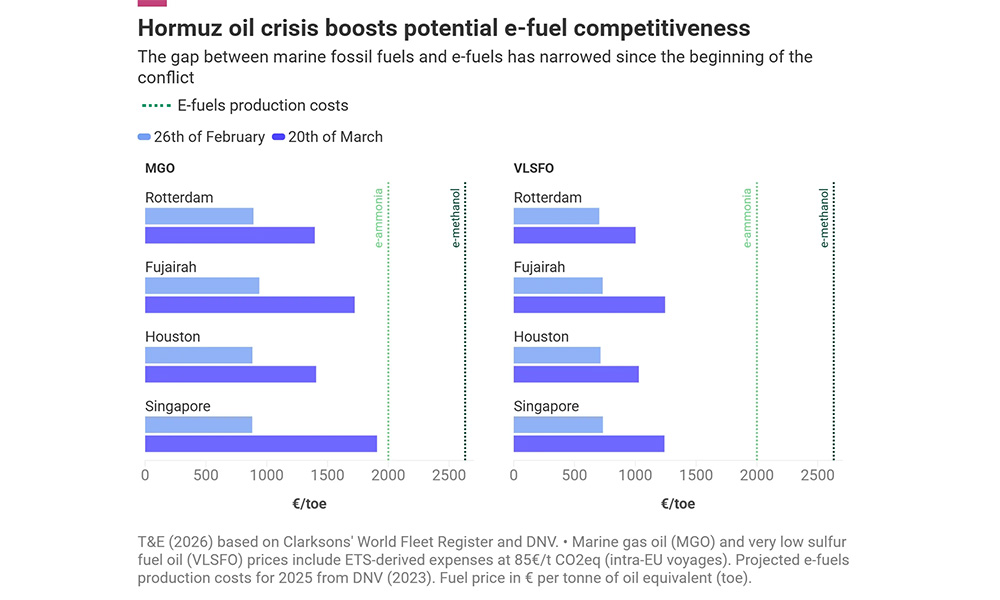
While the trend may be temporary, it shows that the volatility of fossil fuel markets offsets much of the structural cost disadvantage of clean fuels.
“Chaos in the Strait of Hormuz is putting global maritime trade under the spotlight. But it’s on the oil markets where its impact will be felt the most. The war is costing the industry millions every day,” said Eloi Nordé, shipping policy officer at T&E.
“Some governments and parts of the industry have spent the last year bashing green maritime measures as being too expensive, yet those costs pale in comparison to this super-disruption.
“If anything, this crisis should be the catalyst for more investment in European e-fuels and greater uptake of energy efficiency measures to avoid fossil fuel shocks in the future.”
Photo credit: European Federation for Transport and Environment
Published: 2 April 2026

OUR INDUSTRY PARTNERS

China launches methanol shipping supply chain alliance to accelerate green transition

KR, HD Hyundai tap first ammonia dual-fuel sea trial to develop vessel operating standards

DNV awards TADC to Econowind for VentoFoil 3-Series

SEA-LNG: LNG, biomethane bunkering continue to grow despite geopolitical uncertainty

BIMCO Biofuel Clause 2026: Key considerations for owners and charterers

MTF releases new safety guidelines for methanol-fuelled ships

ENGINE: Americas Fuel Availability Outlook (16 July 2026)

US reinstates Iran oil sanctions, orders wind-down by 17 July

ENGINE: East of Suez Fuel Availability Outlook (7 July 2026)

Sea Oil Petroleum boosts Singapore team with new Bunker Trader

NorthStandard issues operational guidance for vessels entering ECAs

ENGINE: Europe and Africa Fuel Availability Outlook (8 July 2026)

Evergreen Marine director questioned, offices searched in Taiwan insider trading probe

OOCL dual-fuel boxship completes first green methanol bunkering op at Qingdao Port
-
 Sanctions1 week ago
US reinstates Iran oil sanctions, orders wind-down by 17 July
-
 Bunker Fuel Availability1 week ago
ENGINE: East of Suez Fuel Availability Outlook (7 July 2026)
-
 Business2 weeks ago
Sea Oil Petroleum boosts Singapore team with new Bunker Trader
-
 ECA1 week ago
NorthStandard issues operational guidance for vessels entering ECAs
-
 Bunker Fuel Availability1 week ago
ENGINE: Europe and Africa Fuel Availability Outlook (8 July 2026)
-
 Legal1 week ago
Evergreen Marine director questioned, offices searched in Taiwan insider trading probe
-
 Methanol2 weeks ago
OOCL dual-fuel boxship completes first green methanol bunkering op at Qingdao Port
-

 Legal1 week ago
Russian court orders marine fuel supplier Transbunker assets transferred to state