
Business
DNV ‘Live from Singapore’ webinar: Panel explores challenges and opportunities in maritime digitalization
Digitalization can help shipping achieve its decarbonization goals but only if human factors are considered enough when introducing smarter maritime operations with ‘user-friendly’ technology.

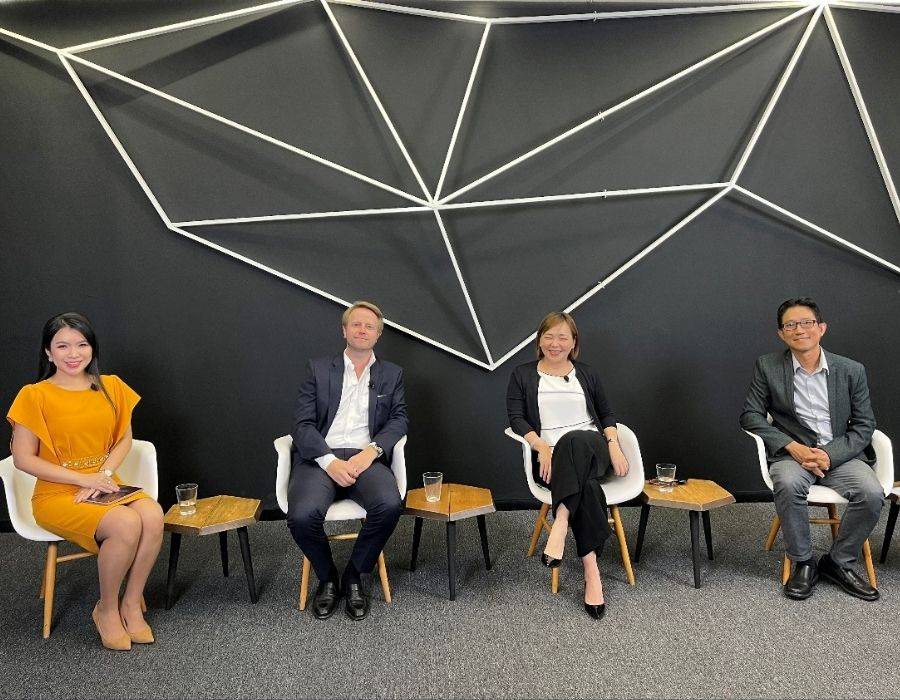
Digitalization can help shipping achieve its decarbonization goals, but only if human factors are considered enough when introducing smarter maritime operations. Technology must be “user-friendly”, so both crews at sea and management teams in port are well-equipped to make the most of it.
These were some of the key points that emerged during DNV’s second ‘Live from Singapore’ webinar on 26 May, from a panel made up of leading industry voices, who focussed on the challenges and opportunities faced by ship owners and ship managers.
Changing mindsets to effectively manage industry transformation is essential, and we need to have systems that communicate with each other, they agreed.
The Benefits of Digitalization
One of the panellists, Caroline Yang, President of the Singapore Shipping Association (SSA) and Chief Executive of Hong Lam Marine, made it very clear that while it might not be easy to introduce digitalization, the benefits are undeniable.
By dealing with the “low hanging fruits” and addressing inefficiencies, she was able to measure a definitive reduction in the carbon footprint – and greenhouse gas emissions – of Hong Lam Marine’s fleet.
Webinar moderator and former CNA news presenter Yvonne Chan pointed out that Hong Lam Marine received the SG Carbon50 Award from the Maritime and Port Authority (MPA) in Singapore last month, in recognition for meeting emission reduction, innovation and scalability.
This was reinforced by panellist Goh Chung Hun, General Manager (Fleet) at Pacific International Lines (PIL), who pointed out the importance of “harnessing the data” collected by artificial intelligence (AI). He said that data, for instance, “tells us when we should clean the hulls of our ships”, helping to reduce fuel consumption, optimize energy use, while also cutting ship emissions in the process.
“Making the best use of the data we now have at our fingertips enables shipowners to better measure and manage their short-term and longer-term sustainable goals,” stated panellist Magnus Lande, DNV Product Line Director and Head of APAC for the industrial digital eco-system and data platform Veracity*, who sees technology as a key enabler in the transition to a low carbon energy system.
(Bio)fuelling up for the Future
In response to the question as to how maritime operations can facilitate lasting change and which smart practices can accelerate effective decarbonization, Mr Goh pointed out that PIL has already embarked on biofuel bunker trials, both for existing vessels and when introducing new ships.
While Used Cooking Oil (UCO) has been successfully trialled in Singapore, PIL is also looking to utilize an algae-based biofuel. Mr Goh made it clear, though, that LNG would continue to be used by PIL as a low carbon fuel.
Caroline Yang was asked, in her role as President of SSA, about the use of mass flow meter (MFM) technology which Singapore has been using for five years for marine refuelling operations.
She said this has created a level playing field for the use of smart technology by significantly reducing bunkering time from ten hours to six, and in some cases, to four hours. “It’s been a game changer!”
The moderator Yvonne Chan asked: “As a leader in maritime guidance and transformation, how does DNV support and empower ship owners in their decarbonization journey?”
Magnus Lande highlighted that DNV recognizes technology and digitalization as key enablers in the transition to a low-carbon energy system, so the company is ready to act as an advisor to all industry stakeholders.
As evidence, he pointed to the continuing research and development (R&D) that DNV undertakes, as well as its willingness to work with the industry on testing and trialling new fuels and systems.

Transforming Attitudes towards Change
Moving onto the challenges involved in implementing “transformative change”, Ms Yang talked about SSA’s Digital Transformation Committee which was specially designed to “uplift Small and Mid-size Enterprises (SMEs)” and help them embark on the digitalization journey.
She pointed out that digitalization is not an easy process and that even in her own company, there had been setbacks. “It’s necessary to change mindsets” to get staff and management onboard for the journey.
With a variety of stakeholders involved, as well as various digital platforms, it is vital to undertake effective training for all, including crews at sea.
“I want to see crews do what they are best at and not complicate their lives at sea or in port. Adopting digitalization should be like using a smart phone,” Ms Yang underlined.
This was reinforced by Mr Goh, who said PIL has set up a “transformation department” to facilitate the digitalization process, as well as to help all stakeholders work towards decarbonization goals.
He stressed the importance of making systems user friendly: “We must engage with our business partners and our customers to make sure we have systems in place that communicate with each other.”
Mr Lande also emphasized the importance of “connectivity” for all stakeholders, as the maritime industry embarks on digitalization and decarbonization at the same time: “Whether it is about alternative fuels or optimizing efficient use of existing fuels, we must make the best use of all the data we now have access to. And DNV is helping companies do just that.”
Gearing up for Cyber Security
The downside of enhanced connectivity and data-driven operations are increased cyber security risks. For DNV, one of the key components in mitigating such risks is the application of human-centred design with technologies that are meant to support human performance.
Ms Chan asked the panellists how companies can be operationally and systematically geared to handle cyber security risks.
Training of crews to be aware of the risks is essential, said Mr Goh. Virtual reality (VR) can be used in training, as this can produce positive results. He mentioned that having “a global advisory group” for cyber security was necessary to both undertake the necessary risk assessment, as well as to have secure software platforms in place.
The panellists agreed that as preparedness for cyber risks involves human aspects, it is vital to keep three key components in mind: people, technology, and processes.
Mr Lande pointed out that all shipping stakeholders need to be aware of the “cyber hazards” but stressed that effective cyber security tools were freely available and that DNV, for one, was there to help companies handle this “very serious topic”.
For Ms Yang, managing cyber security risks must go hand in hand with the transformation journey for digitalization and decarbonization.
For both her own company and SSA, Yang was most encouraged by “just in time” systems which show that it is possible to have seamless deliveries and introduce more efficiencies.
As innovation is happening constantly, Mr Goh admitted that it has proven a challenge for the industry to keep up to date and transform at the same time.
Maximizing the use of available data to drive efficiencies at sea and in port is vital, but we must not underestimate the human factors, the panellists agreed. There is no point in having “human-centred design” if we are not effectively equipping the people to manage change.
*Veracity is DNV’s independent data platform and industry ecosystem. It brings together all the key players in the maritime and energy sectors to drive business innovation and digital transformation. Today, Veracity has over 18 000 companies and 200 000 users on the platform, enjoying frictionless connection through the exchange and sales of datasets, applications and insights. Veracity is a natively born digital unit in DNV, working with global partners to grow an industry network to increase customer satisfaction through speed and automation in service delivery. It provides the means for all participants to build the future by solving today’s problems.
Note:The full recording of the hour-long webinar can be found here.
Related: Future-proofing shipping: The decarbonization game-changer
Photo credit: DNV
Published: 1 June, 2022
Alternative Fuels
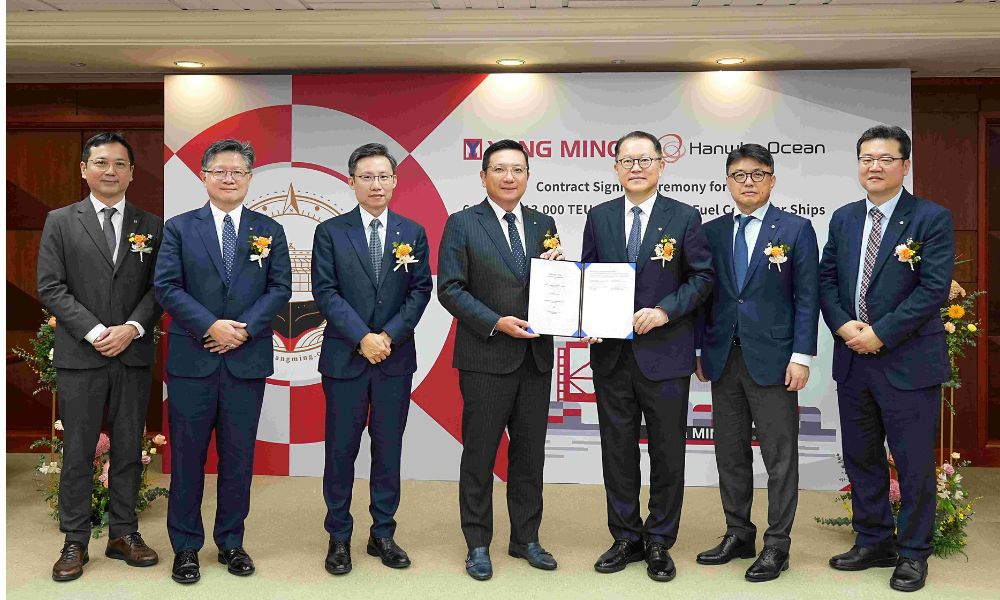
Yang Ming orders six LNG dual-fuel, ammonia-ready containerships from Hanwha Ocean
Each of the six new vessels will have a capacity of up to 13,650 TEU and feature LNG dual-fuel propulsion and Ammonia Fuel Ready specifications.
Alternative Fuels
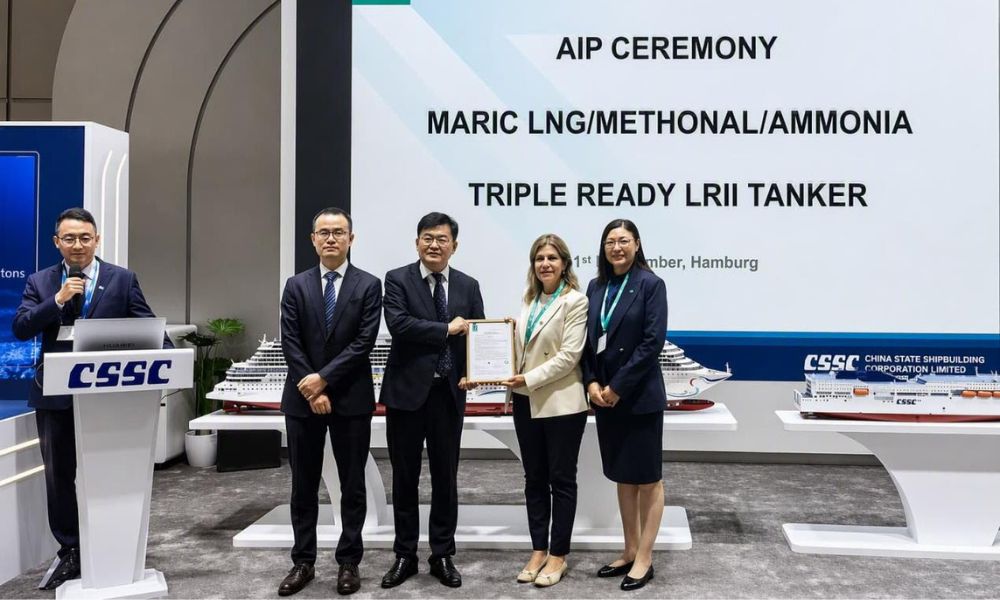
LR, China’s MARIC unveil tanker concept ready for three future bunker fuels
Both secured AiP for a new 114,000 DWT product and crude oil tanker designed to accommodate future conversion to LNG, methanol or ammonia.
Alternative Fuels
DNV: Alternative-fuelled vessel orders hit highest monthly level since October 2024
LNG-fuelled vessels accounted for the vast majority of August activity while the strong summer performance marked a significant acceleration in ordering activity after a relatively slow start to the year.
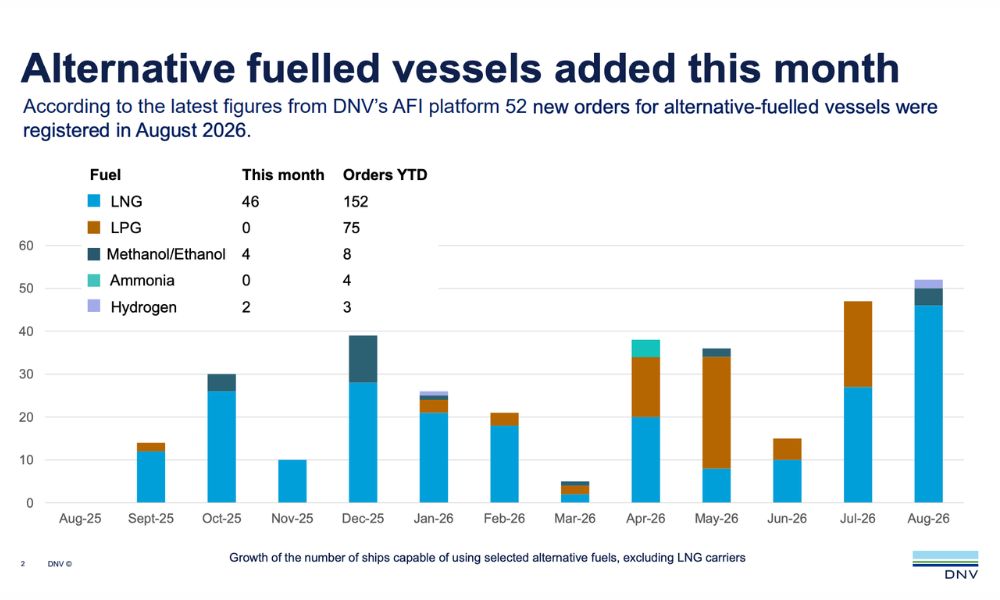
Latest data from classification society DNV’s Alternative Fuels Insight (AFI) platform alternative-fuelled vessel ordering was strong in August, with 52 new vessels added to the platform.
This is the highest monthly total since October 2024 and follows another active month in July, when 47 vessels were added to the database.
LNG-fuelled vessels accounted for the vast majority of August activity, with 46 orders recorded. The container segment led the way with 30 orders, while the car carrier segment contributed a further 12 LNG-fuelled vessels. In addition, four ethanol-fuelled bulk carriers and two hydrogen-powered bulk carriers were added during the month, as well as one LNG bunker vessel.
The strong summer performance marked a significant acceleration in ordering activity after a relatively slow start to the year. In total, 242 alternative-fuelled vessel orders have been placed in the first eight months of 2026, representing a 27% increase compared with the same period in 2025.
LNG remains the dominant fuel choice, accounting for 63% of all alternative-fuelled vessel orders registered so far this year. Container vessels represent the largest share of these LNG orders (59%), followed by car carriers (30%).
Jason Stefanatos, Global Decarbonization Director at DNV Maritime, said: “The past two months have been particularly strong for alternative-fuelled vessel ordering, with August recording the highest monthly total we’ve seen since October 2024. This has helped lift year-to-date orders to a level well above the same period last year.
“LNG remains the leading fuel choice, driven largely by activity in the container and car carrier segments. These sectors have been among the earliest adopters of alternative fuels, supported by predictable liner operations and increasing demand from cargo owners to reduce emissions across supply chains.
“For many owners, LNG offers a combination of emissions reductions, fuel availability and future flexibility while the longer-term fuel landscape continues to evolve.
“At the same time, the latest figures include orders for ethanol- and hydrogen-fuelled vessels, highlighting that owners continue to explore a range of decarbonization pathways. Different segments are making different fuel choices, but the overall level of activity demonstrates continued investment in lower-emission shipping.”
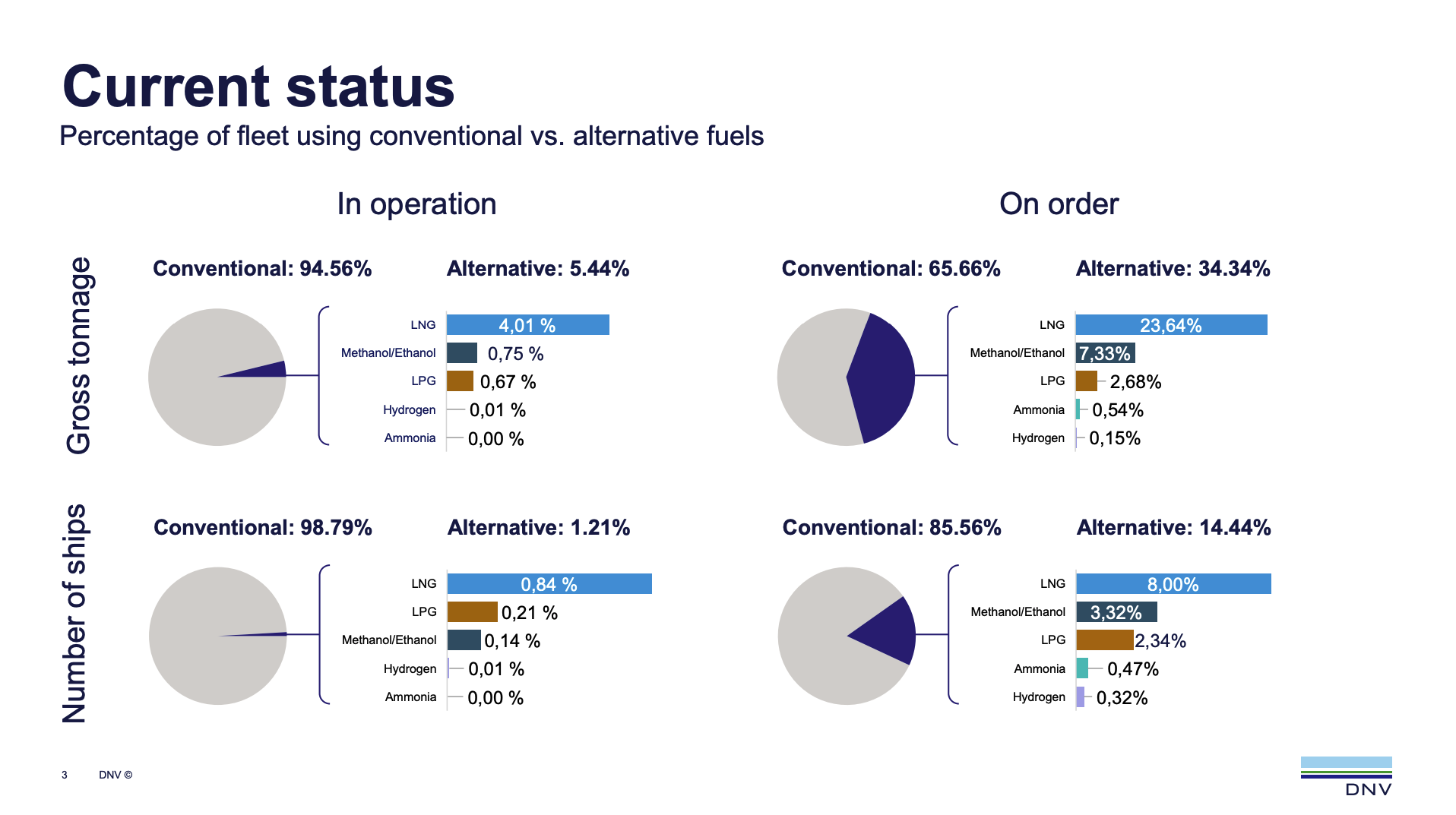
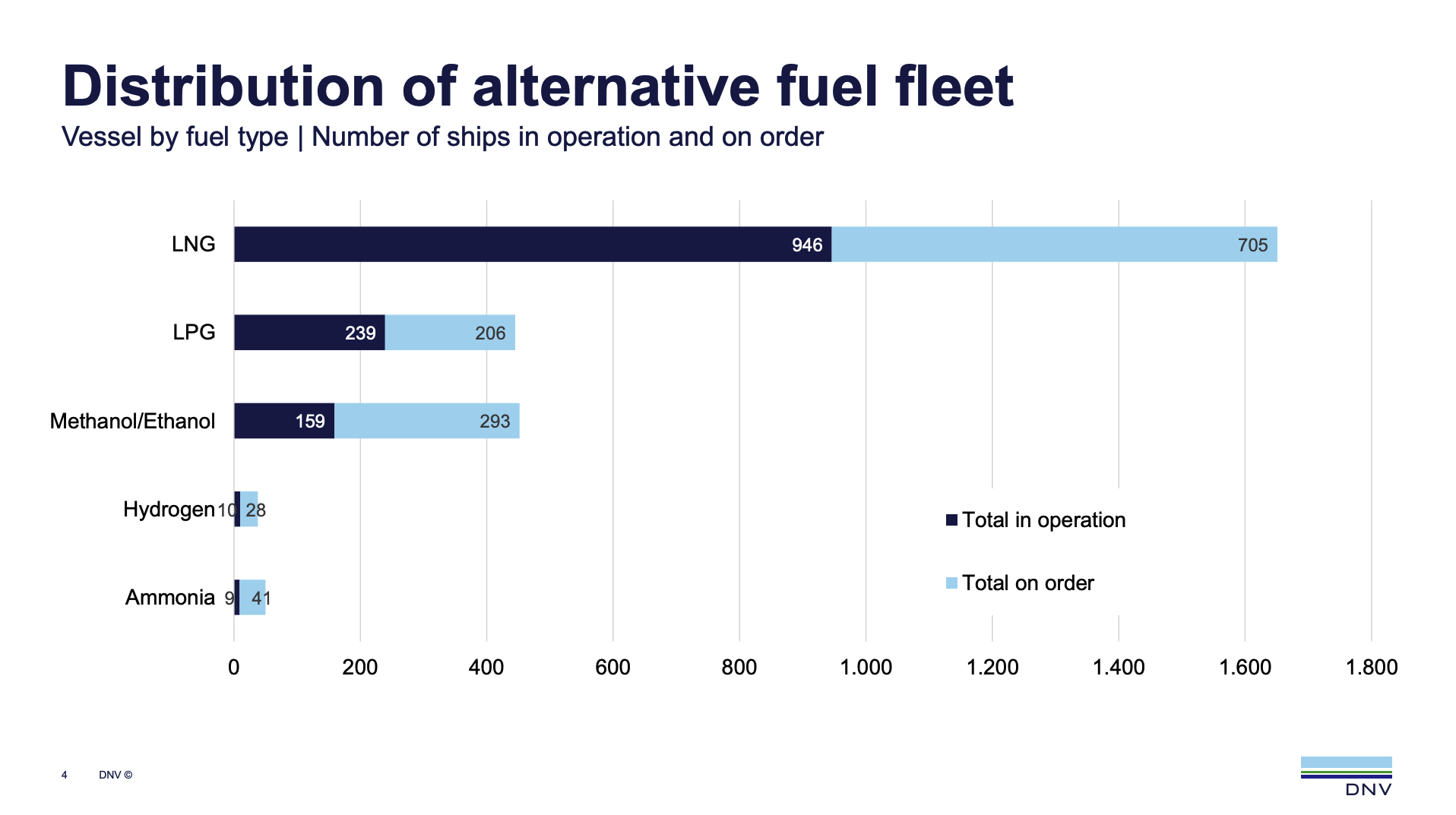
Photo credit: DNV
Published: 4 September, 2026

OUR INDUSTRY PARTNERS

Yang Ming orders six LNG dual-fuel, ammonia-ready containerships from Hanwha Ocean

LR, China’s MARIC unveil tanker concept ready for three future bunker fuels

DNV: Alternative-fuelled vessel orders hit highest monthly level since October 2024

TFG Marine advances global MFM rollout with two US Gulf bunker barges

GENA Solutions: Total renewable and low-carbon methanol project pipeline increases from 61.8 to 62.2 Mt by 2032

Baltic Exchange: Bunker Report (3 September 2026)

ENGINE: Americas Fuel Availability Outlook (3 September 2026)

Singapore-flagged tugboat “Kim Heng 3203” placed under Sheriff’s arrest

US targets five bunker companies in latest sanctions campaign against Iran

Singapore bunkering community supports Living Hope Evangelism’s 7th anniversary outreach for residents in need

China’s bunker market reshaped by tax rebates, trade flows and refining changes, says economist

Hengli Petrochemical’s ex-Singapore trading arm faces winding up application

Report: GCMD outlines practical approach to quantity assurance in marine biofuel supply chains

Singapore: Notices of intended dividend issued for Ocean Bunkering Services, Hin Leong Marine
-
 Vessel Arrest1 week ago
Singapore-flagged tugboat “Kim Heng 3203” placed under Sheriff’s arrest
-
 Sanctions1 week ago
US targets five bunker companies in latest sanctions campaign against Iran
-
 Events2 weeks ago
Singapore bunkering community supports Living Hope Evangelism’s 7th anniversary outreach for residents in need
-
 Interview1 week ago
China’s bunker market reshaped by tax rebates, trade flows and refining changes, says economist
-
 Winding up1 week ago
Hengli Petrochemical’s ex-Singapore trading arm faces winding up application
-
 Biofuel1 week ago
Report: GCMD outlines practical approach to quantity assurance in marine biofuel supply chains
-
 Winding up2 weeks ago
Singapore: Notices of intended dividend issued for Ocean Bunkering Services, Hin Leong Marine
-

 Bunker Claim3 days ago
Rajah & Tann: Bunker disputes are won in the first 48 hours