Connect with us

Business

Exclusive: Estimated annual sales volume for Singapore top bunker suppliers

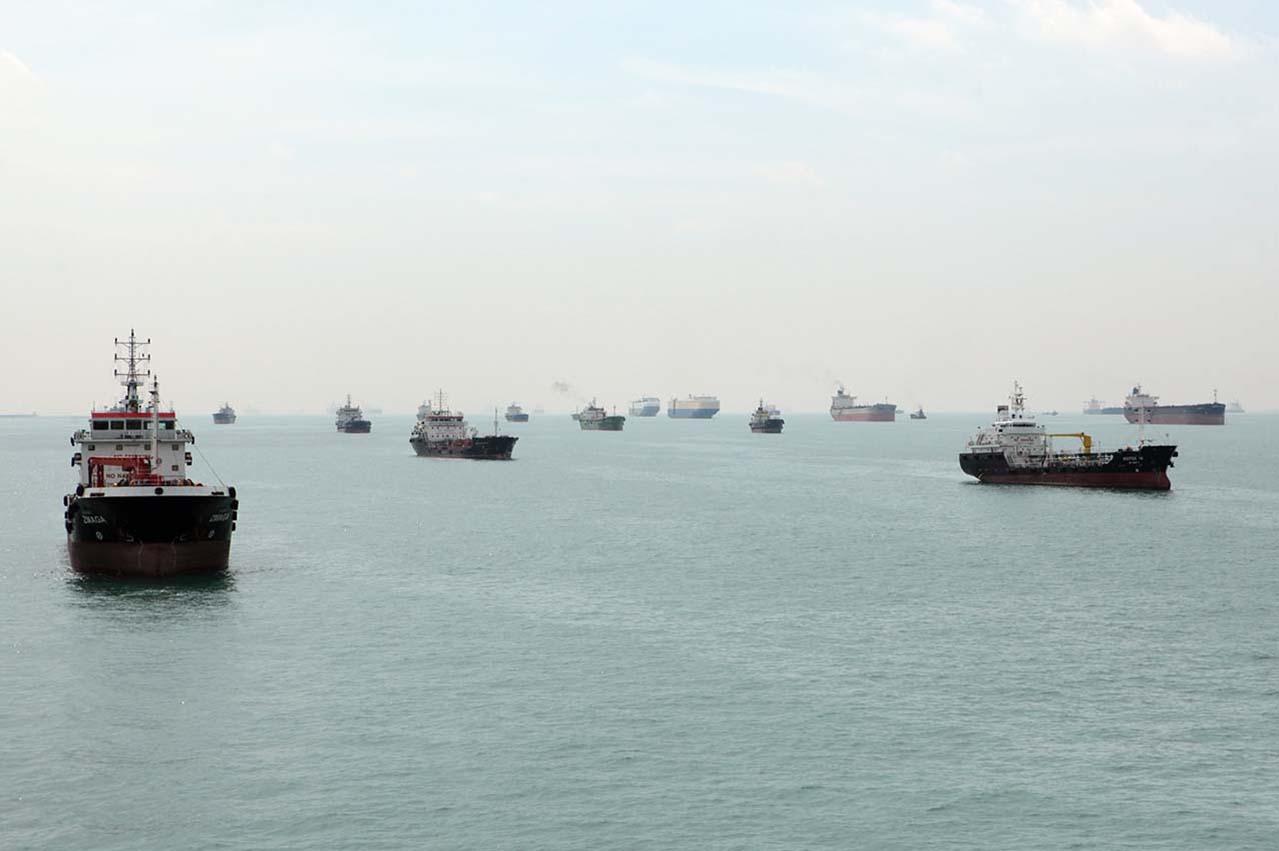
Marine fuel suppliers believed the introduction of MFM technology for bunkering has given them a competitive edge over other ports in the region.

Admin

Published

on

5c500f64a65f6 1548750692

A survey conducted by Singapore marine fuels publication Manifold Times with various industry and company sources estimated the annual bunker sales volume for the republic’s top 10 Singapore bunker suppliers in 2018:
 

Position Bunker Supplier Volume in 2018*
1 Ocean Bunkering Services (Pte) Ltd > 8 million mt
2 PetroChina International (S) Pte Ltd > 4 million mt
3 Sentek Marine & Trading Pte Ltd Unavailable
4 Equatorial Marine Fuel Management Services Pte Ltd 3.5 million mt
5 Shell Eastern Trading (Pte) Ltd Unavailable
6 Total Marine Fuels Pte Ltd 2.7 million mt
7 ExxonMobil Asia Pacific Pte ltd Unavailable
8 Toyota Tsusho Petroleum Pte Ltd 1.8 million mt
9 Maersk Oil Trading Singapore Pte Ltd Unavailable
10 BP Singapore Pte Limited 1.68 million mt

*all volumes estimated from Manifold Times market sources

Overall, the Maritime and Port Authority of Singapore (MPA) accredited marine fuel suppliers believed the introduction of mass flowmeter (MFM) technology for bunkering has given them, and Singapore port, a competitive edge over other ports in the region.

One such supplier was Maersk Oil Trading Singapore which saw most improvement in rankings by rising 18 places from 2017 to be the 9th largest bunker supplier by volume at Singapore in 2018.

The company in January installed the world’s largest bunker MFM unit, the Endress and Hauser Promass X MFM, onboard the Hong Lam Marine-owned high sulphur fuel oil barge MT Eager.

“As a shipowner ourselves, we know that providing superior service and quality in the bunker operation is what customers want in addition to a competitive price,” Peter Beekhuis, Head of Trading – EOS Desk at Maersk Oil Trading, told Manifold Times.

“This means the barge arrives on time, pumps fast and the quality can be relied upon. In the end, this gives the lowest cost of ownership.”

Moving forward, a second installation of the Endress and Hauser Promass X unit is being planned on another Hong Lam bunkering tanker.

Frederic Vazzoler, the Global Sales and Development Director, Marketing and Services, at Total Marine Fuels, attributed the company’s improved position (from 10th place in 2017 to 6th in 2018) to the group’s efforts, in addition to MFMs implementation and customer’s orientation.

“This number was an achievement of many years focus on efforts on continuous improvement projects aimed at offering a higher level of service and satisfaction to our valued customers,” he said.

“The logistic was key and the barge fleet used was really fit for purpose in terms of lot sizes and high safety standards.

“Moreover, as an integrated group we were able to provide different ranges of products such as HFO RMK, RMG and marine gasoil and manage in a good way the turnover of our storages.

“Even if Singapore’s bunker price stayed really competitive; our Bunker Trading & Operation teams have been able to answer to customer demands thanks to long term relationships and shared trust with many of them.

“Now, we see that MFM’s implementation is the only way to follow in order to restore a fair-trade bunker market and prove that oil majors still have an important role to play in the global bunker market.”

In summary, industry veteran Simon Neo believed 2018 to be a good year for the Singapore bunker market.

“2018 was technically a good year for the Singapore bunkering industry,” he says while acknowledging the slight dip of approximately 800,000 mt (-1.6%) from last year’s bunker sales volume.

“We could have seen another year of increase if not because of the quality issues that came out around mid-year for a few months and initial complications from the trade war between China and the U.S.

“Everybody expected the Singapore bunker sales volume to go down drastically but it didn’t.

“MFMs have given us the edge in competition, especially around the region of Asia, where Singapore bunker suppliers have improved in trust from shipowners for quantity.

“Going forward, Singapore will need to address the fuel contamination scare issue and gain back the trust of its customers for quality.”

Related: Maersk Oil Trading installs world’s largest bunkering MFM
Related: Maersk record breaking MFM ‘sets new ops standard’ for bunkering
Related: MPA list reveals top bunker suppliers at Singapore port in 2018

Photo credit: Manifold Times
Published: 29 January, 2019


Continue Reading

Mass Flowmeter

MFM-equipped CPN barge first listed under Hong Kong quality bunker scheme

Chimbusco Pan Nation’s bunker barge “Zhong Ran 23” has become the first vessel in Hong Kong listed on Marine Department’s official List of Quality Bunker Vessels, under a newly-launched scheme.

Admin

Published

on

By

MFM-equipped CPN barge first listed under Hong Kong quality bunker scheme

Hong Kong-based marine fuel supplier Chimbusco Pan Nation (CPN) on Tuesday (16 June) announced that its bunker barge Zhong Ran 23 has become the first vessel in Hong Kong listed on the Marine Department’s official List of Quality Bunker Vessels.

The list under the Quality Bunker Operator Scheme launched on 3 June.

“The Scheme is a voluntary initiative designed to raise the standard of bunkering accuracy, transparency, and service quality in Hong Kong,” CPN said in a social media post.

“To be listed, a bunker vessel must have its Mass Flow Meter (MFM) system independently certified under ISO 22192, the international benchmark for mass flow metering in bunkering operations.”

CPN added it has operated the MFM system across our fleet of fuel oil barges since 2015. 

Manifold Times previously reported Hong Kong’s Marine Department (MD) launching the Quality Bunker Operator Scheme to encourage bunker operators to install and use mass flow meter systems (MFM systems) on their bunker vessels.

MD said the scheme aims to enhance Hong Kong’s bunkering service quality and the competitiveness of Hong Kong ports, thereby further consolidating Hong Kong’s position as an international maritime centre and a major bunkering port.

Under the Scheme, bunker operators of traditional maritime fuel and biodiesel that install and use MFM systems on their bunker vessels, with the MFM systems inspected and certified by an accredited body in accordance with the International Organization for Standardization’s ISO 22192 Standard or equivalent requirements, can apply to the MD for inclusion in the scheme’s “List of Quality Bunker Vessels”, provided they meet the relevant technical and operational requirements. 

Related: Hong Kong backs MFM adoption with voluntary scheme to boost bunkering competitiveness


Photo credit: Chimbusco Pan Nation
Published: 17 June, 2026

Continue Reading

Financial Result

Bunker Holding exceeds FY2025/26 forecast despite geopolitical headwinds

Bunker Holding delivered a gross profit of USD 424 million and a profit before tax of USD 73 million, exceeding the Group’s expectations for the year.

Admin

Published

on

By

RESIZED bunker holding

Bunker Holding on Tuesday (16 June) said it delivered a strong performance in the financial year 2025/2026 despite continued uncertainty across global markets. 

The year was shaped by geopolitical developments, evolving trade flows, periods of heightened market volatility, and strong competition.

These conditions were further amplified by developments in the Middle East, which added complexity across global energy markets and shipping routes. 

In response, Bunker Holding focused on getting closer to customers and understanding the different challenges faced across shipping segments. This enabled faster decision-making, greater agility under pressure, and allowed the Group to respond effectively while continuing to support customers reliably.

Against this backdrop, Bunker Holding delivered a gross profit of USD 424 million and a profit before tax of USD 73 million, exceeding the Group’s expectations for the year. Equity increased to USD 342 million.

Revenue amounted to USD 13.1 billion, a decrease of 4% compared to the previous year. The decline primarily reflected lower average oil prices during the financial year, despite periods of heightened market volatility and stronger pricing towards the end of the period.

“This year, we have taken important steps to strengthen Bunker Holding for the future. We have simplified parts of the organisation, brought teams closer together, and made the changes needed to make us more focused and efficient. Our markets remained challenging and unpredictable, but I am pleased with both the result we have delivered and the progress we have made,” said Peder Møller, CEO of Bunker Holding.        

Looking ahead to 2026/27, Bunker Holding anticipates intense market competition alongside continued investments in low- and zero-carbon fuel projects and partnerships.

Changes to the Board of Directors

Bunker Holding said the company is strengthening its Board of Directors with the appointment of several new members and a new Chairman of the Board.

Nina Østergaard, CEO and co-owner of USTC, will assume the role of Chairman of the Board, while Henrik Andersen, Group President and CEO of Vestas Wind Systems A/S, will join as Vice Chairman. Tina Revsbech, CEO of Maersk Tankers, and Kenneth Steengaard, Chairman of the Board of Global Risk Management, will join the Board as new members.

At the same time, current Chairman Klaus Nyborg and Board member Peter Frederiksen will step down from the Board.

Nina Østergaard, incoming Chairman of the Board, said: “I am excited to take on the role as Chairman of Bunker Holding at an important time in the company’s development. Bunker Holding has a strong market position, a clear strategic direction, and significant opportunities ahead. I am also pleased to welcome Henrik Andersen, Tina Revsbech, and Kenneth Steengaard to the Board. They each bring valuable experience and perspectives, and I am particularly pleased that we have attracted such strong international profiles as Henrik and Tina, whose leadership experience from Vestas and Maersk Tankers will further strengthen the Board and support the company’s continued development.”

The addition of Kenneth Steengaard moves Bunker Holding closer to its sister-company Global Risk Management and adds important insight into risk management.

Bunker Holding founder and co-owner Torben Østergaard-Nielsen thanked the departing Board members for their contributions to the company.


Photo credit: Bunker Holding
Published: 17 June, 2026

Continue Reading

Business

Oilmar establishes Board of Directors amid international expansion

Three directors are Chief Executive Officer Yusif Mammadov, Chief Finance Officer Nain Shafi, and Legal, Credit and Compliance Head Taira Shikhiyeva.

Admin

Published

on

By

Oilmar formalises Board of Directors amid international expansion

UAE-based marine fuel and petroleum products trader Oilmar on Tuesday (16 June) announced the formal establishment of its Board of Directors, marking an important milestone in the company’s evolution.

The three directors are Chief Executive Officer Yusif Mammadov, Chief Finance Officer Nain Shafi, and Legal, Credit and Compliance Head Taira Shikhiyeva.

The formation of the Board was first communicated during Oilmar’s Q1 2026 Townhall as part of a wider governance enhancement initiative and has now been formally implemented.  

The Board has been established to provide strategic direction, oversee risk management and governance matters, and support the company’s continued growth across its global operations.

“At inception, the Board comprises three Directors with extensive international experience across the energy, maritime, shipping, and commodity trading sectors. Together, they bring a wealth of industry knowledge and strategic expertise to support the company’s continued growth and development,” the company said.

“The Board is expected to be further strengthened through the appointment of additional Executive and Non-Executive Directors as the company continues to expand its international footprint.”

As part of the enhanced governance framework, strategic direction, risk appetite, and key business objectives will be determined at Board level, while regional management teams will remain responsible for execution within their respective markets. This structure strengthens accountability, promotes effective decision-making, and supports the Company’s long-term growth and succession objectives.

CEO Yusif Mammadov, said: “The establishment of the Board marks the next stage in Oilmar’s development as a global energy and marine fuels business. It creates a governance framework that will support our future growth, strengthen oversight across the organisation, and ensure that our strategic decisions are guided by long-term value creation and responsible risk management.”


Photo credit: Oilmar
Published: 17 June, 2026

Continue Reading

Trending