Connect with us

LNG Bunkering

Pavilion Energy charters its first LNG bunker tanker from MOL

SG $3 million under MPA’s LNG Bunker Vessel Co-Funding Grant will go into construction of the dual-fuel vessel.

Admin

Published

on

5c7392861a3e7 1551078022

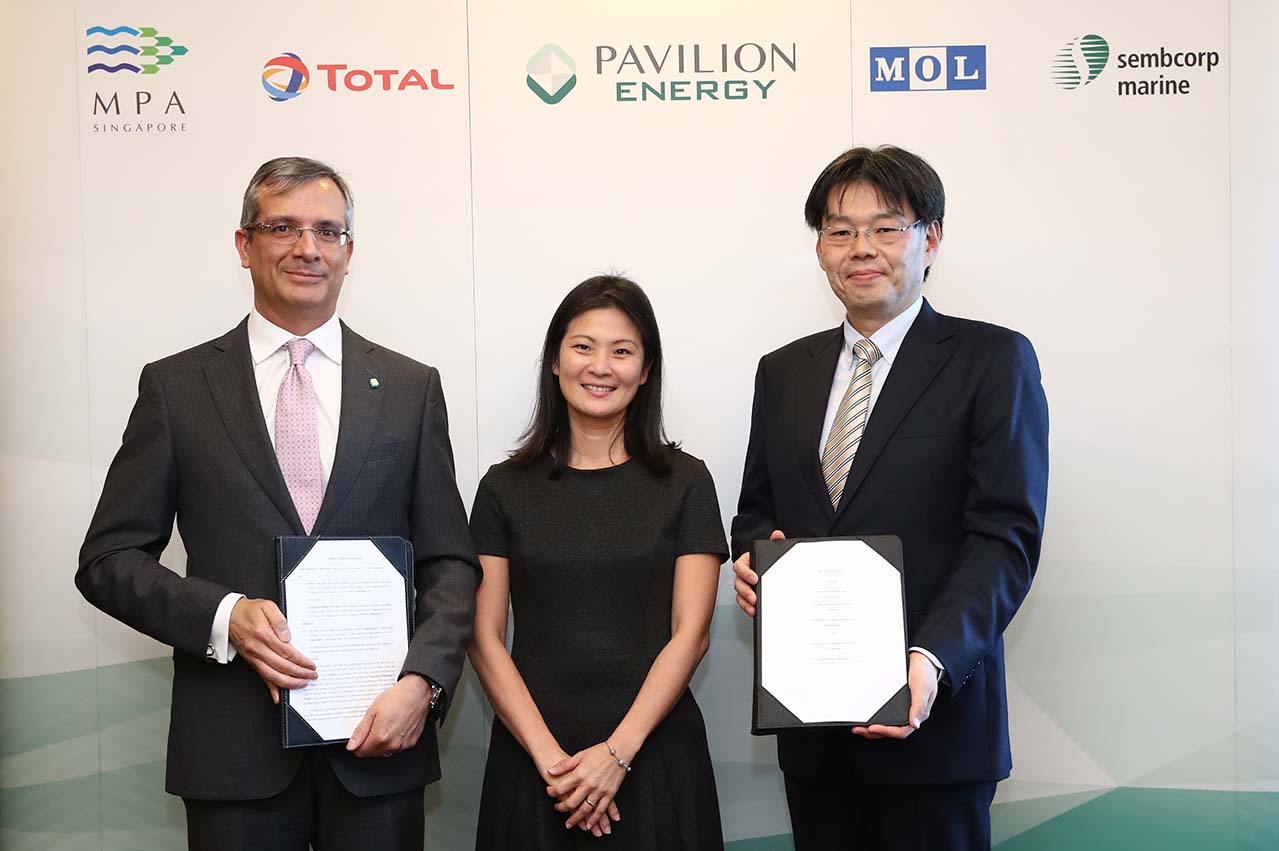
Pavilion Energy on Monday (25 February) said it has chartered its first liquefied natural gas (LNG) bunkering vessel to supply LNG bunkers at the Port of Singapore.

The 12,000 m3 GTT Mark III Flex membrane LNG bunker vessel, which is the largest LNG bunker vessel set for use in the Port of Singapore to date, will be owned by Mitsui O.S.K. Lines, Ltd. (MOL). 

MOL will be collaborating with Singapore-based local bunker tanker owner and operator Sinanju to manage this LNG bunkering vessel.

The vessel will be built by Sembcorp Marine at its shipyard in Singapore for delivery by early 2021.

Featuring a state-of-the-art hull with twin membrane LNG cargo tanks for more efficient boil-off gas management, this vessel fulfills requirements as an LNG feeder and bunker tanker for both coastal and short sea trade.

The SG $3 million (US $2.22 million) grant which was awarded to Pavilion Energy under the Maritime and Port Authority of Singapore’s (MPA) LNG Bunker Vessel Co-Funding Grant will go into the construction of this dual-fuel vessel.

“As the world’s largest bunkering port, we are pleased to support the building of this LNG bunker vessel,” said Quah Ley Hoon, CEO of MPA.

“We look forward to this collaboration catering to growing future demand for ship-to-ship LNG bunkering in the Port of Singapore.”

In June 2018, Pavilion Energy and Total Marine Fuels Global Solutions agreed to co-share the utilisation of this vessel and enable LNG bunker deliveries to both Pavilion Energy’s and Total’s marine fuel customers in the Port of Singapore.

“Pavilion Energy has made substantial headway that will see us supply a cleaner and more sustainable bunker fuel in the Port of Singapore,” said Frédéric H. Barnaud, Group CEO of Pavilion Energy.

“The strategic partnerships with Total and MOL reinforce our commitment to develop robust LNG bunker supply solutions in Singapore as our home base.

“We would like to express our appreciation to MPA and our partners for their strong support behind this important milestone to realise LNG as marine fuel in Singapore.”

Related: Singapore: Total and Pavilion Energy commit to LNG bunkering

Photo credit: Pavilion Energy
Published: 25 February, 2019


Continue Reading

Alternative Fuels

Singapore-based Golden Island, Qingdao Port team up on alternative bunker fuels

Agreement covers green methanol, green ammonia and bio-LNG, with cooperation spanning fuel production and transportation through to storage, sales and bunkering.
Admin

Published

on

By

Golden Island, Qingdao Port team up on green methanol, ammonia and bio-LNG

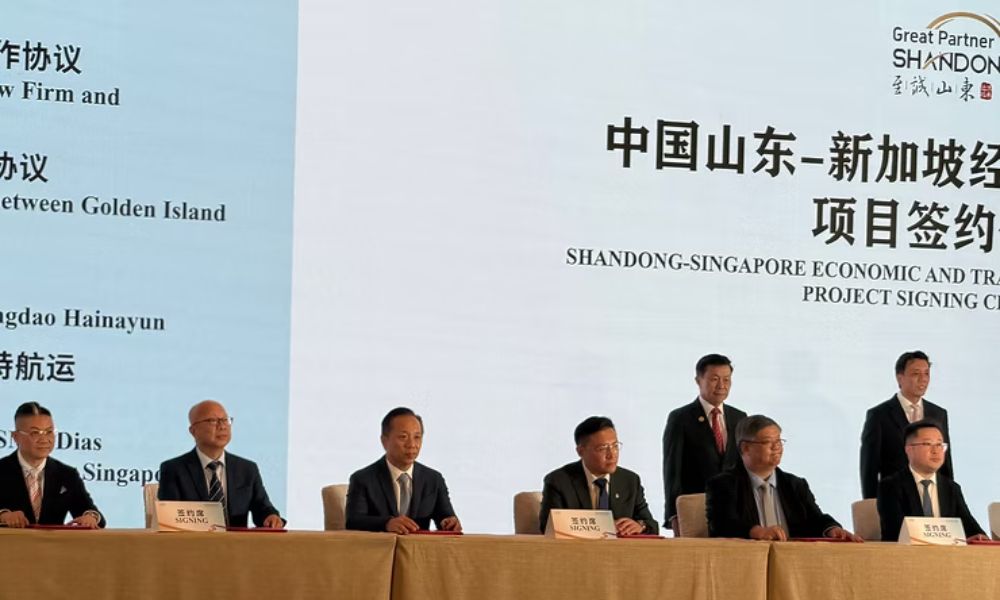
Singapore bunker supplier Golden Island Pte Ltd on Monday (21 September) said it has signed a strategic framework agreement with Qingdao Port International Co Ltd to collaborate on the supply of alternative marine fuels.

The agreement covers green methanol, green ammonia and bio-LNG, with cooperation spanning fuel production and transportation through to storage, sales and bunkering.

“By combining our MPA-licensed bunkering capabilities with Qingdao Port’s incredible logistics and strategic hub position, we are building something truly robust for the global shipping industry’s low-carbon future,” the company said in a statement. 

Qingdao Port International, which operates five major port areas in China, will bring its logistics network, storage facilities and customs clearance capabilities to the partnership.

Golden Island is licensed by the Maritime and Port Authority of Singapore (MPA) to conduct methanol bunkering and is ISCC EU-certified.

The companies are also engaging with container liners, bulk carriers, oil tankers and cruise ships regarding the adoption of alternative marine fuels.


Photo credit: Golden Island Pte Ltd
Published: 22 September, 2026

Continue Reading

Newbuilding

Yang Ming names 15,500 TEU LNG dual-fuel container vessel “YM Weight”

Yang Ming held a naming ceremony at the HD HHI shipyard in Ulsan, South Korea, for “YM Weight”, the fourth vessel in its series of five 15,500 TEU-class LNG dual-fuel container vessels built by HD HHI.
Admin

Published

on

By

Yang Ming names 15,500 TEU LNG dual-fuel container vessel “YM Weight”

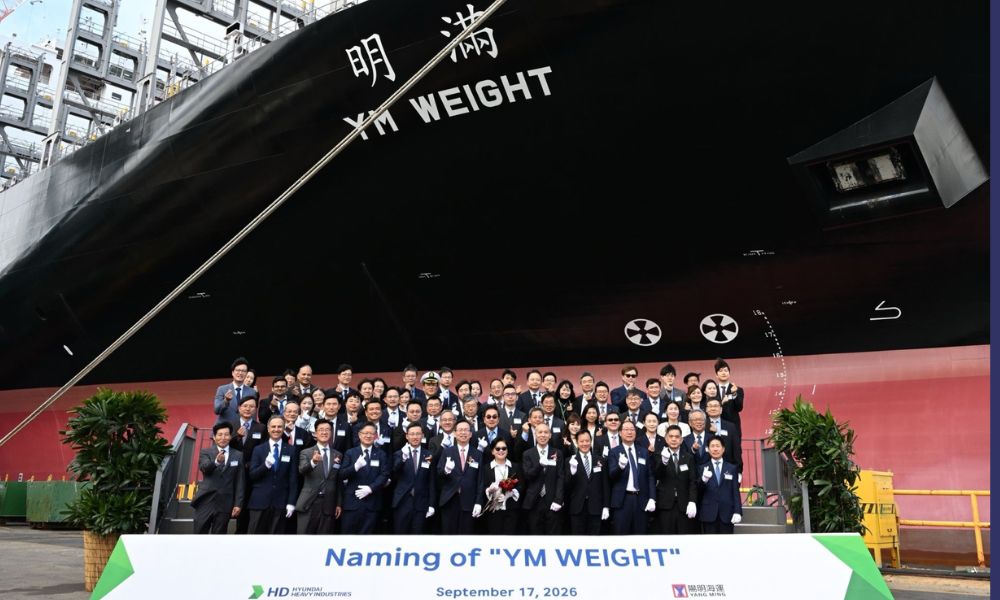
Taiwanese shipping firm Yang Ming Marine Transport Corporation (Yang Ming) on Thursday (17 September) held a naming ceremony at the HD Hyundai Heavy Industries (HD HHI) shipyard in Ulsan, South Korea, for YM Weight, the fourth vessel in its series of five 15,500 TEU-class LNG dual-fuel container vessels built by HD HHI. 

Mrs. Chiu-Lien Lin, the spouse of Administrative Deputy Minister of Transportation and Communications Mr. Kuo-Shian Lin, was invited as the Godmother to officially name the vessel and perform the ceremonial cord-cutting, wishing the ship smooth sailing and full loading on all future voyages. 

This series of vessels built by HD HHI has a length overall (LOA) of 364.97 meters, a breadth of 51 meters, and a capacity of approximately 15,600 TEU. 

The vessels are equipped with high-pressure dual-fuel main engines that run on both LNG and low-sulphur fuel oil, along with integrated navigational information, equipment monitoring, broadband maritime satellite systems, and multiple energy-saving systems to enhance operational efficiency and navigational safety. 

YM Weight, the fourth vessel in the series, is jointly classed by CR and the American Bureau of Shipping (ABS), bringing international classification expertise and capabilities to safeguard the safety and technical compliance of next-generation LNG dual-fuel vessels. 

Furthermore, following proactive underwater noise measurements, the vessel has achieved two industry firsts by receiving the Underwater Noise (UWN) notation from ABS and the Underwater Radiated Noise (URN) notation from CR. The dual recognitions underscore Yang Ming’s commitment to mitigate operational impact on marine life and sustainable development. 

In addition to expanding its next-generation fleet and strengthening its core shipping business, Yang Ming has continued to strengthen professional training for seafarers operating alternative-fuel vessels. 

Yang Ming’s senior Captain Ming-Yeong Pan will serve as the delivery captain of ‘YM Weight’. Captain Pan is the first seafarer in Taiwan to receive the Advanced Training Certificate under the International Code of Safety for Ships Using Gases or Other Low-flashpoint Fuels (IGF Code), Certificate No. 0001, issued by the Maritime and Port Bureau, MOTC. 

To date, 148 Yang Ming officers have completed advanced IGF Code training and will progressively undertake onboard training aboard LNG-fueled vessels and practical alternative-fuel bunkering training. 


Photo credit: Yang Ming Marine Transport
Published: 18 September, 2026

Continue Reading

LNG Bunkering

DNV awards AiP to HD HHI for 12K LNG bunkering ship design tailored to cruise ships

New concept has been specifically designed for bunkering cruise ships, including removal of bridge wings to avoid interference with cruise ships’ lifeboats during operations.
Admin

Published

on

By

DNV awards AiP to HD HHI for 12K LNG bunkering ship design tailored to cruise ships

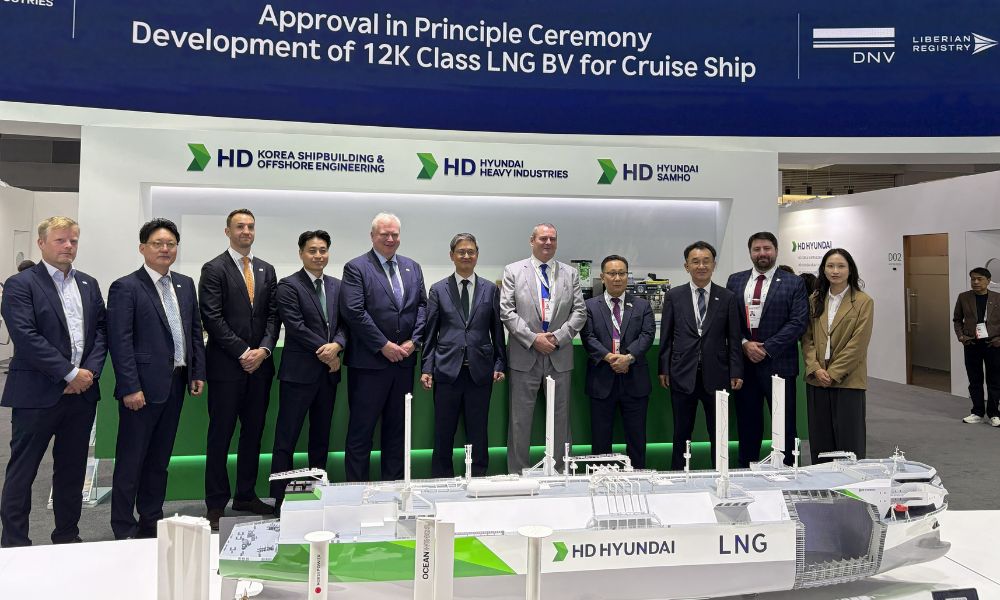
Classification society DNV and the Liberian International Ship and Corporate Registry (LISCR) on Tuesday  (15 September) have awarded an Approval in Principle (AiP) certificate to South Korea’s HD Hyundai Heavy Industries (HD HHI) for a new 12K LNG Bunkering Vessel design, tailored to the needs of cruise ships. 

The AiP was presented to Mr. Ryu Hong Ryeul, CTO / HD HHI, by Vidar Dolonen, Regional Manager for Korea & Japan at DNV, during a ceremony at Gastech 2026 yesterday.

The new concept, a dedicated LNG bunkering vessel (LNGBV) for the cruise segment, has been developed to address the unique operational challenges associated with refueling cruise ships. In particular, unlike conventional designs, the concept removes the bridge wings to avoid interfering with cruise ships’ lifeboats during bunkering operations.

To compensate for the reduced side visibility resulting from the removal of the bridge wings, the vessel is equipped with a CCTV system. In addition, side visibility safety and efficient bunkering operations have been enhanced through the addition of the HiNAS SVM (Hyundai Intelligent Navigation Assistant System Surround view monitoring system), which shows a 360-degree top-view AR image converted from inputs from multiple fish-eye cameras installed around the ship.

Mr. Ryu Hong Ryeul, CTO at HD HHI, said: “By enabling ship-to-ship (STS) LNG bunkering operations without the need for a floating pontoon, this 12K LNGBV bunkering vessel is expected to make LNG bunkering for cruise vessels more efficient and flexible. If this type of LNGBV becomes more widely adopted in the market, this could bring about significant changes in the demand structure and operating models of the LNGBV market because this new type of LNGBV is able to carry out bunkering more freely and flexibly, not only for cruise ships but also for conventional merchant vessels.”

Alfonso Castillero, Chief Executive Officer, Liberian Registry, said: “The Liberian Registry is pleased to support this Joint Development Project, which addresses the specific operational and safety considerations associated with LNG bunkering for cruise ships. The AiP represents an important milestone in advancing a practical and flexible vessel concept while maintaining a strong focus on safety, regulatory compliance and operational reliability.”

Vidar Dolonen, Regional Manager for Korea & Japan at DNV, added: “The transition to lower-emission shipping depends not only on vessels, but also on the supporting infrastructure that enables alternative fuels to be used safely and efficiently. With LNG continuing to play a leading role both the cruise sector and the maritime industry’s decarbonization efforts more broadly, this LNG bunkering vessel concept represents an important step toward building the capabilities needed for the maritime energy landscape.”

An Approval in Principle (AiP) is an independent assessment of a concept within a defined framework of requirements. It confirms the feasibility of the design and verifies that no significant technical barriers exist to its implementation.


Photo credit: DNV
Published: 17 September 2026

Continue Reading

Trending