Connect with us

Technology

BunkerPlanner new feature includes TC rate and vessel speed for bunkering ports

‘Deciding on a port to bunker is a complicated calculation; interwoven are trade-offs related to Time Charter Rate, Speed/Consumption, Deviations and Price,’ it says.

Admin

Published

on

BunkerPlanner

[vc_row][vc_column][vc_column_text]BunkerPlanner, a bunker procurement optimisation tool developed by Scandinavian maritime technology firm BunkerMetric on Tuesday (12 May) said it has rolled out new functionality to assist vessel operators to reduce costs under any market combination of time charter (TC) rate and bunker prices.

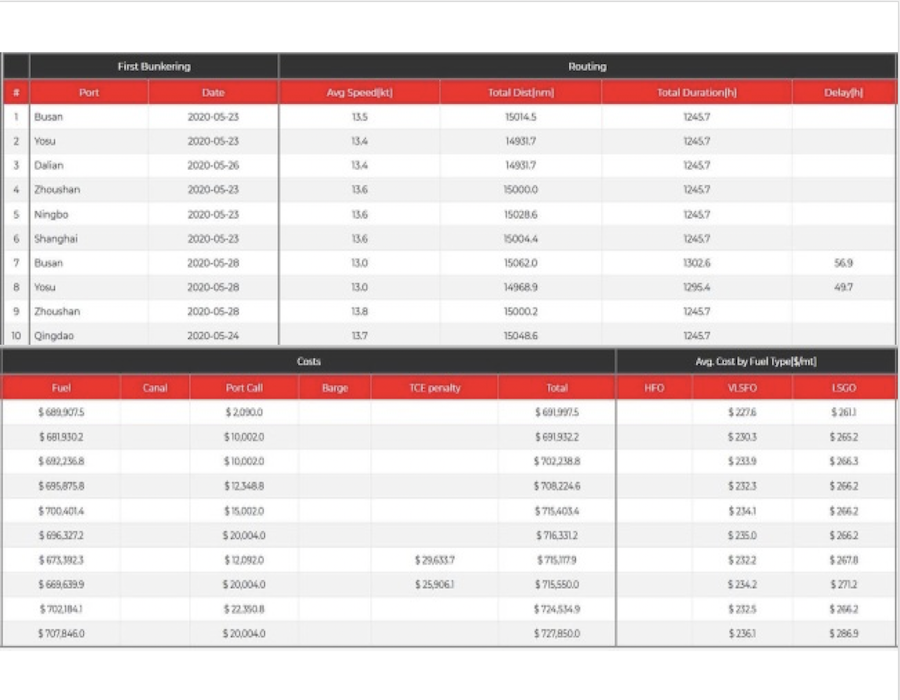
BunkerPlanner says it calculates attractive bunker port calls that can be induced on a voyage in relation to the costs of bunkers, port calls, barges, and deviations, while also taking into account a speed up of the vessel to meet a fixed ETA at next port call. 

The bunker price of any additional port call must justify any speed-up, considering the vessel’s bunker curve and extra distance to be sailed, it stated.

This makes good sense in most high TCE markets, where the expected TC rates exceed the extra bunker cost of speeding up. 

However, there is often an attractive tradeoff by adding a bunker port call and delaying scheduled ETAs while maintaining a fixed speed. 

With this approach a bunker buyer would attain a lower TC rate but would save handsomely on bunkers – a beneficial strategy in low TC environments, it explained. 

Consider an example: 

  • A capesize bulker sailing from Port Hedland, Australia to Qingdao, China and returning, at a sailing speed of 13 knots.
  • At TCEs below $10.000, the most attractive bunker port is Singapore. At very high TCEs, the optimal strategy is to avoid a bunker-only call and lift required bunkers in Qingdao during cargo operations. 
  • The total bunker costs change from $ ~460.000 at very low TCE rates to $476.000 at higher TCE rates. 
  • By identifying the correct strategy, an operator can potentially save more than $16.000, equivalent to over $200 TCE/day.

“Deciding on the cheapest port to bunker is a complicated calculation, which should not be reduced to choosing the lowest $/mt,” said Fernando Alvarez, Bunker Metric co-founder.

“Especially interwoven are the tradeoffs related to Time Charter Rate, Speed/Consumption, Deviations and Price, and are only possible to accurately overview with good system support. 

“With BunkerPlanner’s tool you can easily save hundreds of $ in TCE per day, especially in low TC markets.”

The company notes the bunker prices in the example were locked on the 8th of April 2020. 

It adds that in the current volatile bunker market this rapidly changes and early / mid May, South Korean ports would be preferable on this trade, depending on TC rate. 

Different loading ports in West Australia and discharge in North China, may also give markedly different final results. 

BunkerPlanner says its automated bunker planning tool is of great value in exploring such scenarios.

With this new functionality, which is already available to its customers, the program can even better assist vessel operators to attain significant bunker savings.

“By including TCE in BunkerPlanner’s calculations, advice can also be given bearing in mind the intricate interplay between the optimal speed for a specified voyage, the TC rate, bunker consumption, bunker costs, banal usage and ECA zones,” said Christian Plum, Bunker Metric co-founder.

“Considering all these factors together is powerful, and unique for a Maritime Digitisation tool.”

Related: Dataloy integrates with BunkerPlanner to optimise bunker procurement
Related: BunkerPlanner adds new IMO 2020 functionalities to assist users
Related: ‘BunkerPlanner’ is now available in Asia, says BunkerMetric Co-founder


Photo credit: BunkerPlanner
Published: 13 May, 2020[/vc_column_text][/vc_column][/vc_row][vc_row][vc_column][vc_gallery type=”image_grid” images=”9969″ title=”Additional Information”][/vc_column][/vc_row]

Continue Reading

Mass Flowmeter

NorthStandard: No switching off when bunker mass flow meters are switched on

While Mass Flow Meters have significantly improved transparency and accuracy in bunker deliveries, experience shows that they are not immune to misuse, says Alvin Forster.

Admin

Published

on

By

NorthStandard: No switching off when bunker mass flow meters are switched on

While Mass Flow Meters have significantly improved transparency and accuracy in bunker deliveries, experience shows that they are not immune to misuse, writes Alvin Forster, Senior Loss Prevention Executive – Americas & UK of global marine insurer NorthStandard:

Bunker quantity disputes remain one of the most frequent and contentious causes of claims and charterparty disputes. Traditional measurement methods based on tank soundings, ullage measurements and calibration/sounding tables have long been criticised for susceptibility to error and manipulation. In response, some of the major bunkering ports have mandated the use of Mass Flow Meters (MFMs) as the primary means of measuring the quantity transferred.

MFMs have significantly improved transparency and accuracy, but experience has shown that they are not immune to misuse or deliberate manipulation. Recent enforcement actions, most notably in Singapore, demonstrate that unscrupulous suppliers may attempt to defeat even sophisticated measurement systems.

Singapore pioneered the mandatory use of MFMs. Since 1 January 2017, MFMs have been compulsory for the delivery of marine fuel oil in the Port of Singapore, with the delivered quantity on the Bunker Delivery Note (BDN) derived exclusively from the MFM totaliser.

The regime has continued to evolve. From 1 April 2025, Singapore mandates compliance with SS 648:2024, which tightens requirements around data security, system integrity, piping arrangements, certification, and the use of data loggers and edge devices, reflecting lessons learned from earlier enforcement cases.

Mass appeal for MFMs

From 1 January 2026, MFMs have also been made mandatory on bunker vessels delivering fuel oil, diesel and biofuels at the ports of Rotterdam and Antwerp‑Bruges. The systems must be certified and broadly aligned with ISO 22192, mirroring the Singapore model. The use of MFMs is mandatory across port terminals in Türkiye and at the Port of Ceuta in the Gibraltar Strait, while they are also used in Gibraltar by yacht bunker supplier CEPSA, and others.    

These developments signal a significant shift in the European bunker market, which has traditionally been reliant on shore tank measurements and barge gauging.

Elsewhere, Sohar Port and Freezone have introduced measures that effectively mandate the use of MFMs for bunker supplies. Hong Kong is also looking to introduce regulations that mandate their use, but only for methanol.

Further afield, an increasing number of suppliers are adopting the use of MFMs in ports and hubs where there is no mandate.

Locations where MFMs are currently used on a non-mandatory basis include Fujairah, Zhoushan, Busan, Houston and Prince Rupert (Canada).

Manipulation against the flow

Despite the broadening appeal, and the tamper‑resistant design work that has gone into MFM solutions, there have been instances that show they can still be manipulated through physical or operational interference.

The most well‑known example concerns the bunker tankers Southernpec 6 and Southernpec 7 in Singapore. Between 2016 and 2019, industrial‑strength magnets were placed on the MFM sensors to distort measurement signals, causing the meters to record more fuel than was actually delivered. The fraud resulted in buyers being cheated of over US$300,000 worth of marine fuel oil.

Another recurring manipulation method involves irregular piping arrangements between the MFM and the ship’s manifold. Investigations in Singapore revealed cases where bunker barges had connections allowing fuel to be siphoned back to barge tanks during delivery, inflating MFM readings without the receiving vessel receiving the corresponding quantity.

Such arrangements directly contravene certification requirements but may be difficult for ship crews to detect without detailed inspection.

MFMs have defined operational limits, calibrated for liquid at constant flow. When removing the final amounts from a tank, flow rates may fall outside these parameters, and risk producing unreliable readings.

Guidance for Shipowners and Operators

Despite the increased use of MFMs and the introduction of mandates in some ports, the crew of the receiving vessel should remain vigilant with respect to the way these systems can be manipulated and take measures to protect their position. As a matter of routine, crew should:

  • Always take ship’s bunker tank soundings and witness barge measurements before and after bunkering, even where MFM figures are contractually binding, and retain records.
  • Inspect visible sections of MFM systems, including seals, cabling, and piping.
  • Request to see the MFM bunker system certificate and confirm the unit’s serial number.
  • Engage reputable, experienced bunker surveyors.  
  • Issue letters of protest promptly where discrepancies arise between ship calculations and MFM figures, even if suppliers refuse to countersign.
  • Ensure crews are familiar with bunkering procedures and aware of common manipulation indicators.

Crew should also be aware of the limitations in accuracy when comparing tank measurements with MFM readings. Even when both measurement technologies are accurate, differences can still exist between them.


Photo credit: NorthStandard
Published: 3 July, 2026

Continue Reading

Interview

StormGeo: UAE’s OPEC exit raises stakes for bunker procurement

UAE’s exit from OPEC could weaken the group’s market influence, increasing crude and bunker fuel volatility and boosting demand for digital bunker procurement and voyage optimisation tools, says Julie Louise Nielsen.

Admin

Published

on

By

Julie Nielsen Global Head of Bunker Sales StormGeo MT

Julie Louise Nielsen, Global Head of Bunker Sales at StormGeo, highlighted to Singapore-based bunkering publication Manifold Times that the UAE’s departure from OPEC marks a more significant shift than the earlier exits of Qatar and Angola, reflecting the country’s strategic importance as a major producer with substantial spare capacity.

Nielsen said the move is expected to increase uncertainty in crude and marine fuel markets, prompting shipping companies to strengthen bunker procurement strategies through greater use of digital decision-support platforms: 

MT: How significant is the UAE’s departure from OPEC compared with previous exits by Qatar and Angola, and what does it mean for OPEC’s ability to influence global oil markets?

The UAE’s exit is materially more significant than Qatar’s or Angola’s because the UAE has been one of OPEC’s most strategically important producers, with meaningful spare capacity and a much larger role in market balancing. Qatar’s departure in 2019 and Angola’s in 2024 were important politically, but they were smaller in market impact. The UAE’s move is therefore more than symbolic – it raises a real question about how much cohesion OPEC can still maintain, and whether the group can continue to steer prices as effectively as it has in the past.

MT: How might this development affect expectations for crude oil and marine fuel prices over the next 12 to 24 months?

In the next 12 to 24 months, I would expect the market to price in a little less discipline and a little more uncertainty. If the UAE uses its new flexibility to lift output, that could cap upside in crude over time, but the bigger effect may be on volatility rather than direction. For marine fuel buyers, that means more frequent swings in bunker costs and less confidence that prices will stay in a narrow range for long. In StormGeo we already see a spike of interest for our s-Bunker solution which includes one of the market’s most advanced bunker planner solutions. Companies are facing the issue of keeping up with the market volatility, and see the benefits of having a solution recommending where to bunker and how much, as well as having a full audit trail of the decision to prove that this was the right decision at the time. We have also lately hosted a webinar about this, which also showed us the real interest from the market, with many participants as well as many good questions.

MT: Could the weakening of OPEC’s cohesion lead to more regional disparities in bunker fuel pricing across major ports?

Yes, most probably. A less cohesive OPEC means the market becomes increasingly influenced by regional supply dynamics and geopolitical events rather than coordinated production policy. For shipping, the Strait of Hormuz remains one of the most critical chokepoints, with around one-fifth of global oil passing through it. Any disruption – whether from political tensions, security incidents, or shipping restrictions – can quickly affect crude availability, freight costs, insurance premiums, and ultimately bunker prices in ports across the Middle East and Asia. As a result, we are likely to see greater regional price disparities, where local market conditions become just as important as movements in global crude benchmarks.

MT: How does increased fuel price volatility affect bunker procurement strategies and voyage planning?

Volatility pushes shipping companies to be much more disciplined in how they buy fuel and plan voyages. Instead of relying on fixed assumptions, they need to time purchases more carefully, compare more ports, and test whether a deviation or a different stem location actually improves net voyage economics. It also makes scenario planning more important, because a small change in bunker price can quickly alter voyage margin, cargo economics, and even routing decisions. I foresee that those companies who are not considering going digital on bunker management will fall short compared to their competitors who have already implemented a fully digital process for their voyage optimization.

MT: How can digital bunker management and voyage optimisation platforms help shipowners navigate a more volatile fuel market?

Digital platforms help by giving owners better visibility, faster decision-making, and a more consistent way to compare fuel options across ports, suppliers, and voyage scenarios. In a volatile market, the value is not just automation – it is control: being able to see expected cost, compare alternatives quickly, and lock in a better decision before the market moves. They also help reduce manual work, which matters when procurement teams are making more decisions under tighter time pressure. What I believe is important as well is to not silo the voyage optimizations. Combining your full voyage optimization with a software provider having a full end-to-end solution is key, to ensure that all decisions are made on the same data inputs. In StormGeo, we are proud of being a one-solution provider, and we do see that this is becoming a growing requirement from the market.

MT: Have you observed growing demand from shipping companies for real-time bunker pricing and procurement tools in recent years? Could you share some data to demonstrate this?

Yes, without question. Over the past few years, we’ve seen a clear shift in how shipping companies approach bunker procurement. Rising fuel costs, increased market volatility, and a greater focus on operational efficiency have all driven demand for real-time pricing, market intelligence, and digital procurement tools.

That said, we still meet companies that believe their current manual bunker procurement process is the right way of working. A common response is, “We’re already performing well.” I never challenge whether they are doing something wrong – that’s for them to conclude. Instead, I ask a simple question: How do you know you’re performing well if you’re not using data to measure it? And this questions are very often not being met with an answer, but more a questionable expression. In today’s shipping industry, where digital solutions are transforming almost every operational process, I still find it surprising that some organizations remain hesitant to embrace data-driven decision-making in bunker procurement.

Companies that have adopted digital solutions are no longer looking for a simple list of bunker prices. They want the ability to compare suppliers, evaluate alternative bunker ports, understand the commercial impact of different procurement strategies, and make informed decisions based on real-time market intelligence. This is particularly important when fuel remains one of the largest operating expenses for a vessel.

We continue to see growing adoption of digital bunker management solutions among both shipowners and operators, and our onboarding pipeline continues to grow. More companies are moving away from manual, spreadsheet-based processes towards integrated platforms that combine live pricing, procurement workflows, voyage planning, and advanced data analytics. Based on customer performance reviews conducted after implementing our platform, we frequently see bunker cost improvements of up to USD 30 per metric tons compared with previous manual procurement processes. Beyond the direct financial savings, the objective is to improve transparency, reduce administrative workload, and enable procurement teams to make faster, more informed decisions in an increasingly volatile fuel market.


Photo credit:StormGeo
Published: 1 July, 2026

Continue Reading

Alternative Fuels

Hitachi Zosen Marine Engine orders Mitsubishi Shipbuilding ammonia fuel handling system

MAmmoSS® will be designed and optimised to be compatible with the ammonia marine engines of Everllence SE and WinGD and will be used for shop tests of both engines after delivery to HZME’s facility.

Admin

Published

on

By

Hitachi Zosen Marine Engine orders Mitsubishi Shipbuilding ammonia fuel handling system

Mitsubishi Shipbuilding Co., Ltd., a part of Mitsubishi Heavy Industries (MHI) Group, on Friday (26 June) said it has received an order from Hitachi Zosen Marine Engine (HZME) for its MAmmoSS® ammonia fuel handling system.

HZME is a dual licensee of Everllence SE and WinGD, major licensors of marine engines. MAmmoSS® will be designed and optimized to be compatible with the ammonia marine engines of these two licensors, and after delivery to HZME’s facility, will be used for shop tests of both engines.

The company said decarbonisation in global shipping is a critical issue, and ammonia, which does not emit CO2 when burned, is attracting attention as a next-generation marine fuel that will significantly contribute to reducing GHG emissions in the shipping industry. 

“However, as ammonia is a toxic fluid, safe handling technology onboard ships is essential and is expected to drive demand for MAmmoSS®,” it said. 

Going forward, Mitsubishi Shipbuilding said it will continue to provide safe and reliable products for ammonia-fuelled vessels to support the expected market expansion.


Photo credit: Mitsubishi Shipbuilding
Published: 30 June, 2026

Continue Reading

Trending